
CURRICULUM · BOTH PROGRAMS
Forward Deployed Engineer Course Syllabus: Full FDE Curriculum
The complete forward deployed engineer course syllabus for both FDE Masters programs: the 18-week Career Program and the 10-week Advanced Program, every week, every tool, every assessment rule, and what we deliberately leave out.
18-week Career track · 10-week Advanced track
20+ production tools, one persistent client: Deccan Finance
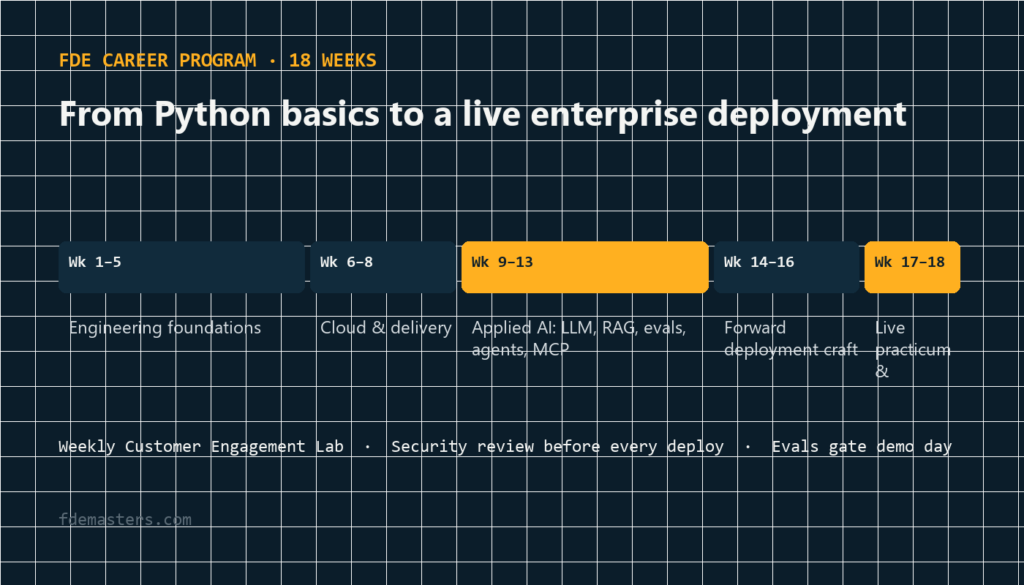
Evals gate demo day · security review before every deploy
What does the forward deployed engineer course syllabus cover?
This forward deployed engineer course syllabus covers four layers: software and cloud foundations, LLM systems (RAG, evals, agents, MCP), enterprise deployment (identity, integration, security, infrastructure inside the customer's walls), and consulting craft (discovery, SOW, demos, adoption). Both programs end with a real 2-week forward deployment and a demo day.
The syllabus is reverse-engineered from what a forward deployed engineer (FDE) actually does at Palantir, OpenAI and Anthropic, and from Bloomberry's analysis of 1,000 FDE postings: Python in 66 percent, AI agents in 35 percent, TypeScript in 35 percent, AWS in 32 percent, and customer work listed first in 55 percent of postings.
Pick the track that matches your experience. The Career Program starts from Python for beginners and early-career engineers; the Advanced Program starts at LLM engineering for engineers with 2 to 7 years. The FDE skills guide maps each skill to the week it is taught.
Key takeaways
▸
Two tracks, one spine: weekly Customer Engagement Lab, the Deccan Finance client, security review before every deploy, evals as the gate to demo day, and a live 2-week deployment.
▸
Career Program: 18 weeks, 16 teaching plus 2 practicum, roughly 180 live and 200 lab hours, four graded projects.
▸
Advanced Program: 10 weeks, 8 teaching plus 2 practicum, roughly 100 live and 120 lab hours, three projects.
▸
Tools: Python, FastAPI, Postgres and pgvector, TypeScript and Next.js, AWS, Docker, GitHub Actions, Kubernetes, Terraform, Claude and OpenAI APIs, LangGraph, Claude Agent SDK, MCP, Langfuse, RAGAS, promptfoo, ServiceNow and Salesforce sandboxes, Claude Code.
▸
Certificates are earned, not attended: you must pass every project, the security review and the practicum.
Six design principles that make this FDE curriculum different
Most AI courses stop at a working notebook. An FDE's job starts there. These six principles shape every week of both programs.

1. One persistent client: Deccan Finance
A fictional mid-size NBFC with loan books, policies, legacy SQL Server data, ServiceNow tickets and difficult stakeholders. Every lab and project builds on the same client, so you graduate with one coherent enterprise case study.
2. Weekly Customer Engagement Lab
Every Friday you practise the non-code half of the job: discovery calls, scoping PRDs, SOW sections, executive status notes and demos, with trainers role-playing CFOs, CISOs and sceptical ops managers.

3. Security review before every deploy
Nothing goes to a shared environment without a threat model, PII check and evidence note. Taught with SOC Masters faculty so you learn how a client's security team actually thinks.

4. Evals are the gate to demo day
Each project ships with a golden dataset and a CI eval gate. If pass rate drops below the threshold, the demo is cancelled. This is how OpenAI's FDE engagements run: scoping, validation with evals, delivery.

5. A real forward deployment, not a capstone
For two weeks you are embedded with a Brolly Group business unit or a Digital Brolly SME client. Real users, real data constraints, real deadlines, and a demo to people who will keep using what you built.

6. Demos in English and Telugu or Hindi
Indian enterprise stakeholders switch languages mid-meeting. You practise explaining architecture, risk and ROI in English and in Telugu or Hindi, because adoption depends on being understood.
FDE Career Program syllabus: 18 weeks
Monday to Friday, 2 live hours a day, plus the Friday Customer Engagement Lab. Weeks 1 to 8 build engineering foundations; Weeks 9 to 16 build LLM systems and enterprise delivery; Weeks 17 to 18 are the live practicum and placement.
Week 1
FDE role, Linux, Git, Python I
The forward deployed engineer role and operating model, shell and Git workflows, Python fundamentals. First Deccan Finance discovery call in the lab.
Week 2
Python II
Object-oriented design, type hints, dataclasses, exceptions, pytest and fixtures. Tests before features from this week on.
Week 3
SQL, Postgres and messy enterprise data
Joins, window functions, indexes, data cleaning with pandas, handling the inconsistent loan-book exports Deccan Finance sends.
Week 4
APIs: REST, FastAPI, OAuth2, JWT
Build authenticated, documented REST services with pagination, rate limiting and error contracts.
Week 5
TypeScript, React, Next.js, Project 1
Front-end basics for internal tools. Project 1: internal ops dashboard for the collections team.
Week 6
AWS core and cost
IAM, EC2, S3, RDS, VPC, budgets and tagging. Deploy Project 1 into a private VPC.
Week 7
Docker and CI/CD with GitHub Actions
Multi-stage builds, container registries, pipelines that run tests and security scans on every pull request.
Week 8
Kubernetes, Terraform, observability, Project 2
Infrastructure as code, deployments and services, logs, metrics, traces. Project 2: reproducible deployment of the full stack.
Week 9
LLM fundamentals
Tokens, context windows, structured outputs, Claude and OpenAI APIs, prompt design, cost and latency budgets.
Week 10
RAG
Chunking strategies, pgvector, hybrid search, rerankers, permission-aware retrieval and citation quality.
Week 11
Evals and observability
Golden datasets, LLM-as-judge, RAGAS, promptfoo, CI eval gates and Langfuse tracing in production.
Week 12
Agents and MCP
Tool calling, LangGraph, Claude Agent SDK, human-in-the-loop checkpoints, guardrails, and building MCP servers.
Week 13
Enterprise integration, identity, Project 3
SSO with OIDC and SAML, RBAC, ServiceNow and Salesforce via MCP, SQL Server and ERP, SQS and Kafka. Project 3: enterprise agent.
Week 14
Discovery and scoping
MECE structuring, pyramid principle, scoping PRD and statement of work written from a live discovery session.
Week 15
Security, compliance, governance
OWASP LLM Top 10, prompt injection, PII, DPDP Act 2023, SOC 2, GDPR, HIPAA and the evidence pack, with SOC Masters faculty.
Week 16
Delivery, UAT, adoption, exec demos, Project 4
UAT plans, adoption metrics, change management and the executive demo. Project 4: the complete Deccan Finance solution.
Week 17
Live practicum
Embedded forward deployment with a Brolly Group business unit or Digital Brolly SME client.
Week 18
Demo day, case study, interview prep, placement
Employer council demo, published case study, mock interviews and the start of placement assistance.
FDE Advanced Program syllabus: 10 weeks
Three weekday evenings of 2 hours plus Saturday 4 hours. Assumes you already code; every week goes straight to production concerns.
Week 1
FDE operating model and LLM engineering
Engagement structure at Palantir, OpenAI and Anthropic. Structured outputs, context management, API cost and latency budgeting.
Week 2
Production RAG on messy data
Ingestion from PDFs, spreadsheets and SQL exports, pgvector, hybrid search, rerankers, permission-aware retrieval. Project 1.
Week 3
Evals as engineering
Golden datasets, LLM-as-judge, RAGAS, promptfoo, Langfuse and CI gates as the release criterion.
Week 4
Agents and MCP
LangGraph, Claude Agent SDK, tool design, human-in-the-loop, guardrails and MCP servers for enterprise systems. Project 2.
Week 5
Enterprise integration and identity
OIDC and SAML SSO, RBAC, ServiceNow and Salesforce via MCP, SQL Server and ERP connectors, SQS and Kafka.
Week 6
Deployment inside the customer's walls
Kubernetes, Terraform, private VPC, on-prem constraints, model gateways and air-gapped considerations.
Week 7
Security, compliance and governance sign-off
OWASP LLM Top 10, prompt injection, PII, DPDP Act 2023, SOC 2, GDPR, HIPAA. Evidence pack with SOC Masters. Project 3.
Week 8
Consulting craft and value proof
SOW, stakeholder alignment, ROI model, executive status notes, written case study, demos in English and Telugu or Hindi.
Week 9
Live practicum
Forward deployment with a Brolly Group business unit or Digital Brolly SME client, scheduled around your job.
Week 10
Demo day and placement
Employer council demo, case study publication, mock interviews and entry into the interview pipeline.
Tools taught in the FDE curriculum
Layer
Tools
Career Program
Advanced Program
Languages and frameworks
Python, FastAPI, TypeScript, React, Next.js
Weeks 1 to 5
Assumed; refreshed in labs
Data
PostgreSQL, pgvector, pandas, SQL Server connectors
Weeks 3, 10, 13
Weeks 2, 5
Cloud and infrastructure
AWS (IAM, EC2, S3, RDS, VPC), Docker, GitHub Actions, Kubernetes, Terraform
Weeks 6 to 8
Week 6
LLM APIs and agents
Claude API, OpenAI API, LangGraph, Claude Agent SDK, MCP
Weeks 9, 12
Weeks 1, 4
Evals and observability
Langfuse, RAGAS, promptfoo
Week 11
Week 3
Enterprise systems
ServiceNow and Salesforce developer sandboxes, OIDC and SAML SSO, SQS, Kafka
Week 13
Week 5
Security and compliance
OWASP LLM Top 10 tooling, PII scanners, evidence pack templates
Week 15
Week 7
Developer productivity
Claude Code
Throughout, from Week 2
Throughout
Assessment rules: how you earn the certificate
Both certificates, Associate for the Career Program and Professional for the Advanced Program, are earned by passing assessments, not by attendance.
▸
Every project is graded on four criteria: correctness and tests, eval pass rate against the project's golden dataset, security review outcome, and a timed stakeholder demo.
▸
A project passes at 70 percent or above. You may resubmit once within one week with written feedback from the trainer.
▸
No project reaches demo day unless its CI eval gate is green. A failing eval cancels the demo until fixed.
▸
The practicum is assessed by the host business unit on scope delivered, communication and handover quality, plus the trainer's review of your code and evidence pack.
▸
Customer Engagement Lab participation is required: at least 80 percent of Friday labs attended live or completed asynchronously with a recorded submission.
▸
Attendance target is 80 percent of live sessions; recordings cover genuine absences but do not replace lab submissions.
▸
Certificates are issued within 2 weeks of demo day and carry a verification ID. Details are in the FDE certification guide.
What this FDE syllabus does not cover
Being explicit about scope helps you plan. These topics are out of scope or covered only briefly.
▸
Training or fine-tuning foundation models. You will call Claude and OpenAI APIs and open-weight models through gateways, not pretrain or fine-tune them.
▸
Deep machine learning theory, linear algebra or classical ML modelling. We teach what an FDE needs to evaluate and deploy, not to research.
▸
Data science dashboards and BI tooling such as Power BI or Tableau beyond what Project 1 needs.
▸
Azure and Google Cloud in depth. AWS is the teaching cloud; concepts transfer and we point to equivalents.
▸
Mobile app development, game development and embedded systems.
▸
Sales quota ownership. You learn discovery, scoping and SOW writing, but the course does not train you as an account executive.
▸
Job placement guarantees. We provide placement assistance and an interview pipeline; outcomes are published on the placements page.
Frequently asked questions
What is the forward deployed engineer course syllabus at FDE Masters?
It is a two-track syllabus. The 18-week Career Program covers Python, SQL, APIs, Next.js, AWS, Docker, Kubernetes, Terraform, LLM fundamentals, RAG, evals, agents, MCP, enterprise integration, discovery, security and delivery, then a live practicum. The 10-week Advanced Program covers the same LLM and enterprise layers at a faster pace for engineers who already code.
Which programming languages does the FDE course teach?
Python is the primary language for services, data pipelines, agents and evals. TypeScript with React and Next.js is taught for internal dashboards and front ends. SQL is used throughout on PostgreSQL and SQL Server connectors. This matches Bloomberry's 1,000-posting analysis where Python appears in 66 percent and TypeScript in 35 percent of FDE job descriptions.
Does the syllabus include MCP and AI agents?
Yes. Week 12 of the Career Program and Week 4 of the Advanced Program cover tool calling, LangGraph, the Claude Agent SDK, human-in-the-loop checkpoints, guardrails and building MCP servers. Week 13 and Week 5 then connect agents to ServiceNow and Salesforce sandboxes through MCP with SSO and RBAC, which is the work Anthropic's own FDE job description lists.
What projects will I build in the FDE course?
Career Program learners build four graded projects for Deccan Finance: an internal ops dashboard, a reproducible Terraform and Kubernetes deployment, an enterprise agent with MCP and permission-aware RAG, and a complete solution with SOW, security sign-off, UAT and executive demo. Advanced learners build three. Both tracks finish with a real 2-week forward deployment. See what FDEs build.
How is the FDE curriculum assessed?
Each project is graded on correctness and tests, eval pass rate, security review and a timed stakeholder demo, with 70 percent as the pass mark and one resubmission allowed. CI eval gates must be green before any demo. The practicum is assessed by the host business unit and the trainer. Certificates are issued only after all components pass.
Is the online syllabus the same as the classroom syllabus?
Yes. Live online learners follow the identical week-by-week syllabus, same trainer, same Deccan Finance labs, same Customer Engagement Lab, same projects, same security review and the same live practicum. Sessions are recorded for revision. The only differences are the fee and the room you sit in; see online training.
Want to see the syllabus taught, not just listed?
The free demo class runs one real Deccan Finance exercise from the curriculum and ends with a frank discussion about which track fits you. Download the detailed PDF syllabus at the demo.